MVP of a real-time learning system
Using existing research signals to align products around a shared strategic pain point.
The decision at risk
Should the organization continue optimizing individual products, or align around a shared customer pain point?
Acting on fragmented signals could lead to disconnected investments and missed systemic opportunities.
Why it was risky
Why this mattered
Years of research existed across the company, but valuable insights remained isolated instead of driving coordinated action.
My point of view
Research creates value when it changes decisions.
Organizations rarely lack customer feedback. What they often lack is a way to connect signals, identify patterns and transform evidence into coordinated action.
What I needed to understand
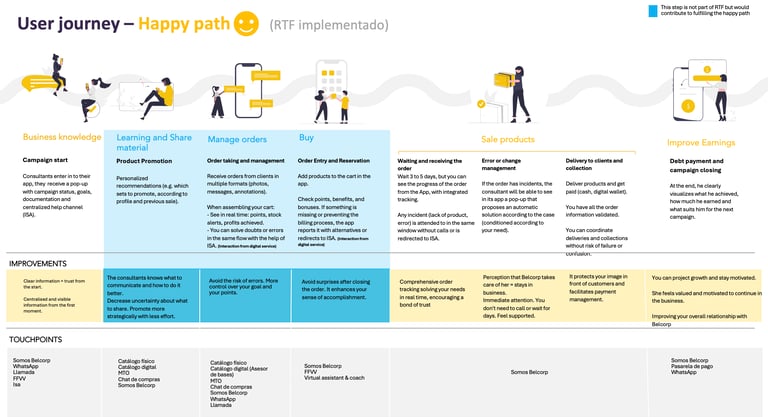
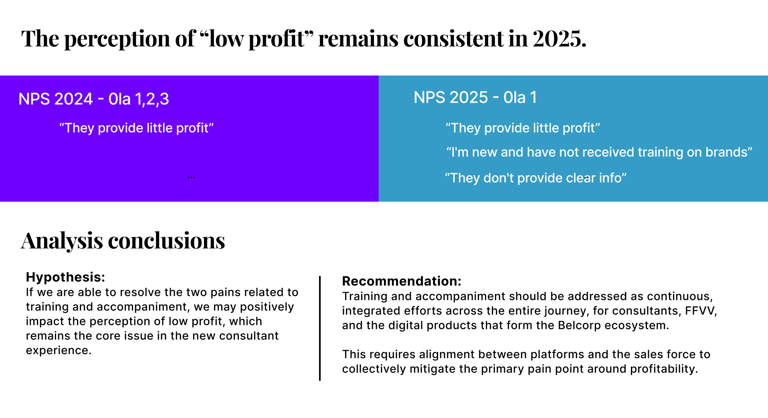
Reviewing NPS feedback across multiple products.
Synthesizing findings from field research conducted over several years.
Analyzing customer service categorizations and call center data.
Connecting qualitative and quantitative evidence to identify recurring patterns.
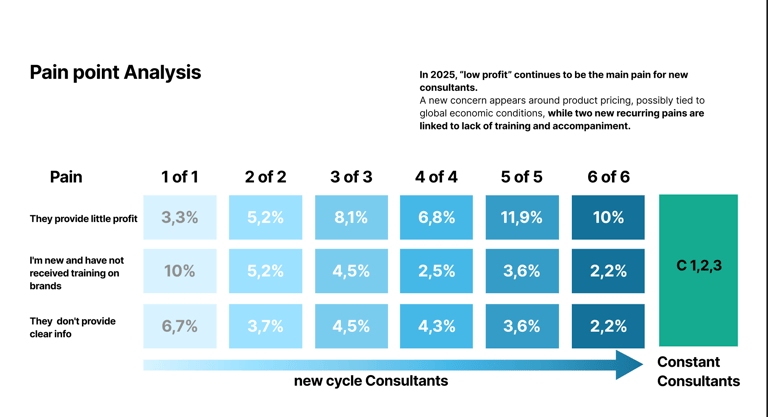
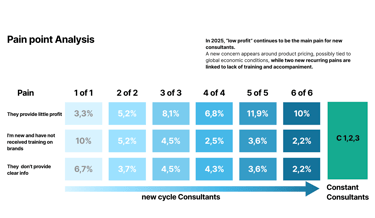
Mapping relationships between user pain points and product experiences.
Building an MVP framework that simulated how a real-time feedback ecosystem could operate before investing in a full solution.
Socializing hypotheses, findings and recommendations with product teams to validate strategic relevance.
What signals already existed across the organization.
Which pain points consistently appeared across multiple research sources.
Whether different products were experiencing the same underlying user problem.
How existing evidence could be synthesized into a shared strategic narrative.
Which opportunities deserved cross-product attention.
How this was explored
What changed?
Research signals were connected into a shared view
Teams aligned around a common user pain point
Insights became actionable across the ecosystem
Research existed in isolated repositories
Teams optimized individual products
Evidence was fragmented across sources
Before
After
Decisions unlocked
Which customer pain point deserved ecosystem-level attention.
Where multiple products could collaborate instead of operating independently.
Which hypotheses required further validation.
How research investments could generate value beyond a single product.
How future feedback loops should be structured.
System impact
Multiple research sources were consolidated into a single strategic narrative.
Product teams gained visibility into shared customer challenges.
Discussions shifted from assumptions and anecdotes to evidence-based prioritization.
The initiative demonstrated how existing research could function as an organizational learning system rather than isolated projects.
A shared direction emerged for future discovery and product investments.
The challenge wasn't collecting more feedback.
It was connecting the signals already available.
Important trade-off
Learning was prioritized over automation.